 Changelly
Changelly is a wallet-to-wallet swap workflow built around network and address checks
Changelly is a crypto swap interface where the important decision happens before payment: match the input asset to its network, enter a receiving address for the output network, review the amount and rate type, then send only to the fresh deposit address displayed for that order. After the wallet broadcasts payment, the deposit gathers blockchain confirmations; the service exchanges the asset and sends the payout to the recorded recipient address.
Table of contents
It is a crypto swap interface where users compare asset and network choices, verify the destination address, send payment.
A matched route for moving value between two wallet accounts
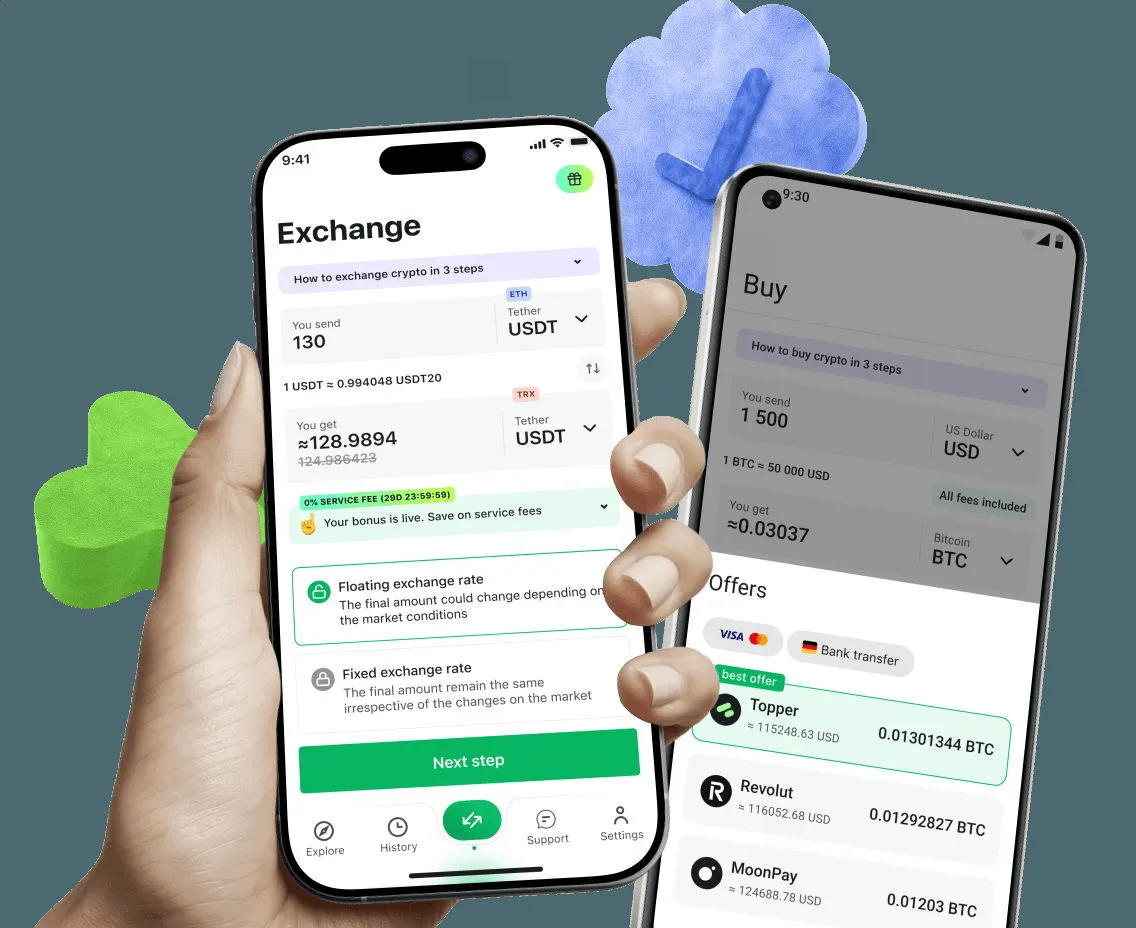
A route from TRC-20 USDT in TronLink to ETH in a Ledger Live account is defined as two separate network choices. The input side must say USDT on TRON, while the output side must say ETH on Ethereum. The amount comes from the sending balance; the recipient address comes from the Ethereum account's receive screen. The quote then shows the rate type, estimated output, exchange fee, network fee, and expected processing time before confirmation.
The form presents two rate modes: fixed and floating. Changelly assigns a floating-rate pay-in address for 3 hours. A standard fixed-rate address has a 15-minute payment window, while BTC, XMR, LTC, DCR, EOS, GAS, BNB, and VET fixed-rate inputs receive 20 minutes. That timer governs when the incoming transfer must appear on its blockchain. It does not count the later confirmation period or payout transfer.
Network labels must agree even when addresses look identical
A network label decides which ledger records the payment, even when two wallets display the same account string. Ethereum Mainnet uses chain ID 1, BNB Smart Chain uses 56, and Polygon PoS uses 137. MetaMask and Trust Wallet may show one 0x account across all three networks, yet each network maintains separate balances and token contracts. ERC-20 USDT on Ethereum and its BEP-20 counterpart on BNB Smart Chain are therefore different transfer routes.
Other chains expose stronger visual differences. A TRON Base58Check address has 34 characters and begins with T; its raw form is 21 bytes with a 0x41 prefix. A Solana account address encodes a 32-byte value in Base58. Bitcoin mainnet addresses commonly begin with 1, 3, bc1, or bc1p, and a bc1p Taproot destination carries a version 1 witness program of 32 bytes. Those patterns reject some category errors, but the selected network still controls settlement.
Recipient address, pay-in address, and extra ID serve different jobs
The recipient address receives the output asset, while the pay-in address receives the input asset for this particular order. Changelly displays its pay-in address only after the order details are confirmed, and that address is non-reusable. Copying the recipient into the payment field reverses those roles. Some fixed-rate routes also show a separate refund-address field for returning the input if the exchange cannot complete.
An extra ID routes a payment within a shared account system. On the XRP Ledger, a destination tag is a 32-bit unsigned integer, so its protocol range runs from 0 through 4,294,967,295. Stellar supports a text memo up to 28 bytes, a 64-bit memo ID, and two hash memo forms of 32 bytes each. The order supplies the exact tag or memo type; the wallet field must reproduce both its value and its format.
The five-point review before a wallet signs
The final review should prove five separate matches before any wallet signs or broadcasts payment. Each check connects a field on the order to a field visible in the sending or receiving wallet.
- Input: The ticker and network match the balance being sent, such as USDT marked TRC-20 in TronLink.
- Output: The selected asset and network are supported by the receiving account, such as ETH on Ethereum.
- Recipient: The full address was copied from that receiving account, with no deleted characters or added spaces.
- Extra ID: A memo or destination tag is included only when the displayed pay-in or recipient details require it.
- Payment: The amount, fee treatment, active timer, and newly generated pay-in address all match the current order.
A Ledger or Trezor device shows the address and amount on its own screen, while MetaMask and Trust Wallet show the active network in the transaction view. That device check authorizes the source-chain transfer; it does not revise any route field already recorded in the order.
What changes after the payment is broadcast
A broadcast payment turns the order from an instruction screen into an on-chain transfer awaiting recognition. Before broadcast, the Created status only means Changelly has issued an internal transaction ID. The normal path uses six named statuses in sequence: Created, Waiting for payment, Confirming, Exchanging, Sending, and Finished. Confirming starts once the input transfer is detected and remains until the displayed confirmation requirement is met.
Confirmation time comes from the input chain rather than the quote timer. Ethereum offers a block opportunity every 12 seconds and groups 32 slots into a 6.4-minute epoch, but the order's required confirmation count remains a separate interface value. Exchanging means the confirmed input has entered the exchange stage. Sending means the output transfer has been issued to the recipient; Finished closes the recorded workflow.
An invalid-address message is a setup error with a clean reset
An "Invalid address" message means the entered string fails the selected asset or network validator. The Changelly validator catches malformed length, alphabet, prefix, checksum, and whitespace where the chosen format exposes them. It cannot infer EVM chain intent from a valid 0x string because Ethereum, BNB Smart Chain, and Polygon PoS share the same account shape.
An EIP-55 Ethereum address uses a 20-byte value displayed as 40 hexadecimal characters after the 0x prefix. Its mixed-case encoding supplies about 15 check bits on average, leaving a 0.0247% chance that a random typing error still passes the checksum. Bitcoin Bech32 rejects mixed case, while Solana Base58 is case-sensitive. Changing capitalization by hand is therefore not a universal repair.
Clear the field, reselect the intended output network, open that network's receive screen in the wallet, and copy the address again without surrounding spaces. If validation still fails, the wallet is exposing a different asset format. Leave the unpaid order alone and create a new one after the fields agree; an unpaid order expires without a blockchain transfer.
How one deposit becomes one payout under the hood
The order record links one quoted route to one expected blockchain deposit and one payout destination. Changelly creates the internal transaction ID and a fresh pay-in address, plus a tag or memo where the input network needs one. An ordinary ERC-20 payment is a token transfer from the user's wallet to that address; the standard exchange flow does not require a standing token allowance.
Deposit monitoring matches the source-chain transfer to the order through the pay-in address, extra ID, asset, network, and amount. Once the required confirmations arrive, the exchange stage processes the selected pair and creates a separate transaction on the output chain. The payout transaction uses the recipient and memo recorded before payment. It cannot inherit a corrected address from a wallet screen opened afterward.
Verify the payout on its destination chain
Payout verification requires both the order record and the destination chain's transaction record. A Changelly transaction ID identifies the off-chain order; it is not the payment hash or payout hash. Save all three identifiers. A Bitcoin transaction ID represents a 32-byte hash displayed as 64 hexadecimal characters. An EVM transaction hash is also 32 bytes, displayed as 66 characters including 0x, while a Solana transaction identifier is a Base58 encoding of a 64-byte signature.
Use the explorer for the actual payout network: Etherscan for Ethereum, BscScan for BNB Smart Chain, PolygonScan for Polygon PoS, TRONSCAN for TRON, Solscan for Solana, XRPScan for the XRP Ledger, or Stellar Expert for Stellar. Check successful execution, recipient, asset or token contract, amount, and memo where applicable. If the explorer shows the correct token transfer while the wallet balance display lags, switch the wallet to the destination network and refresh its account data.
Changelly: reader questions
Is a small test transfer appropriate for a fixed-rate Changelly order?
A test transfer should use a separate Changelly order, not become the first installment of a fixed-rate payment. The fixed order expects the stated amount at its fresh pay-in address within its timer, and a later top-up does not complete the original deposit automatically. Create a smaller order above the displayed minimum, verify its payout, then create the intended order with a new address.
How much native coin should remain for an ERC-20 or TRC-20 payment?
The sending wallet needs enough native coin to cover the network's live transaction fee. ERC-20 transfers on Ethereum spend ETH for gas, BEP-20 transfers on BNB Smart Chain spend BNB, TRC-20 transfers on TRON consume TRX-funded resources, and Polygon PoS uses POL. Read the wallet's fee estimate before broadcast; the required amount is separate from the token quantity entered in the order.
Does scanning the payment QR code prove the selected network is correct?
No, a payment QR code mainly transfers the address and sometimes an amount or payment URI into the wallet. Wallets interpret URI fields differently, and a valid EVM address can exist in the same textual form on several chains. After scanning, compare the wallet's active network, asset ticker, full destination, amount, and any extra ID with the current order screen.
Should a centralized exchange deposit address receive the swapped asset?
A centralized exchange deposit address works only when that venue accepts the exact output asset and network shown in the order. Copy the venue's current deposit address and include its memo or destination tag when supplied. An address from its Ethereum deposit screen does not authorize a BNB Smart Chain or TRON payout, even when the account owner and token ticker appear identical.
Are token contract addresses interchangeable with recipient wallet addresses?
No, a token contract address identifies the token deployment, while a recipient address identifies the account that should receive it. Pasting the USDT contract into the recipient field does not direct USDT to the user's wallet. Obtain the recipient from the wallet's receive screen for the selected network; use the contract address only to confirm or add the token definition in that wallet.
How does a new token appear when the recipient wallet has never held it?
A compatible wallet account can receive an ERC-20, BEP-20, or TRC-20 token without holding that token beforehand. After the payout settles, the wallet may require the correct network to be selected and the token contract to be added to its asset list. The explorer record distinguishes a display issue from an address issue by showing the recipient and token transfer directly.
What refund address belongs in a fixed-rate Changelly order?
A refund address must accept the original input asset on the exact input network. For a TRC-20 USDT payment, use a TRON address that can receive TRC-20 USDT; an Ethereum address for the desired ETH output serves a different role. Enter a refund address only when the form requests one, and copy it from a wallet account you control.
First published