 Changelly
Changelly is a Cross-Chain Crypto Swap Service with Fixed and Floating Rates
Changelly is a brokered crypto swap service: "cross-chain" means exchanging assets on separate blockchains, while a quote states the expected receiving amount. It routes a user's deposit through partner trading venues, then sends the purchased asset to a wallet address supplied by the user. Fixed quotes protect the displayed output when payment rules are met; floating quotes follow the execution-time market rate.
In short: A fixed-rate order requires the exact input to reach its fresh pay-in address within the displayed 15-20-minute window.
Network mismatches and compliance holds interrupt the shortest route
Network selection and compliance review are the two consequential failure points in a Changelly exchange. USDT on Ethereum follows ERC-20, USDT on Tron follows TRC-20, and the BNB Smart Chain version follows BEP-20. An EVM-style address alone does not identify the ledger: Ethereum Mainnet uses chain ID 1, while BNB Smart Chain uses 56. Sending the correct ticker through the wrong network leaves the service without the deposit specified by the order.
Shared deposit accounts add a second routing element beyond the address. An XRP Ledger destination tag is a 32-bit unsigned integer, while a Stellar text memo holds up to 28 bytes. When the quote displays a tag, memo, or extra ID, that value and the address form one complete destination. Omitting either component prevents automatic attribution of the transfer.
Compliance screening can move a funded exchange into Hold status. The documented KYC process supports requests for government identification, residential details, and evidence explaining the source of funds. Settlement resumes only when the review is complete, so the user gives up immediate control of the deposited asset during that interval. This intermediary exposure is materially different from an atomic smart-contract swap.
Prepare both wallets before requesting a quote
Wallet preparation comes before rate selection because the order needs a source asset, a destination asset, and a compatible receiving address. The service supplies one fresh pay-in address per transaction and assigns a separate internal transaction ID. Pay-in addresses are non-reusable, so a later exchange begins with a new order even when the asset pair remains unchanged.
A fixed-rate flow also requests a refund address for the source asset. Three user-side address roles matter in a fixed order: the source wallet, the receiving wallet, and the source-asset refund wallet. The source wallet must send the precise amount shown, while the receiving wallet must support the selected output network and any required memo or tag. The pair minimum is displayed with the quote; it reflects the output network fee and the smallest lot accepted by the trading route rather than a permanent platform-wide threshold.
The documented exchange flow supports continuation without an account, while email or Google sign-in preserves history. Wallet integrations listed for Ledger, Trezor, and Exodus place the same exchange mechanism inside familiar interfaces, yet the transaction still has its own pay-in address, quote rules, and support record. Review those fields before authorizing the source-chain transfer.
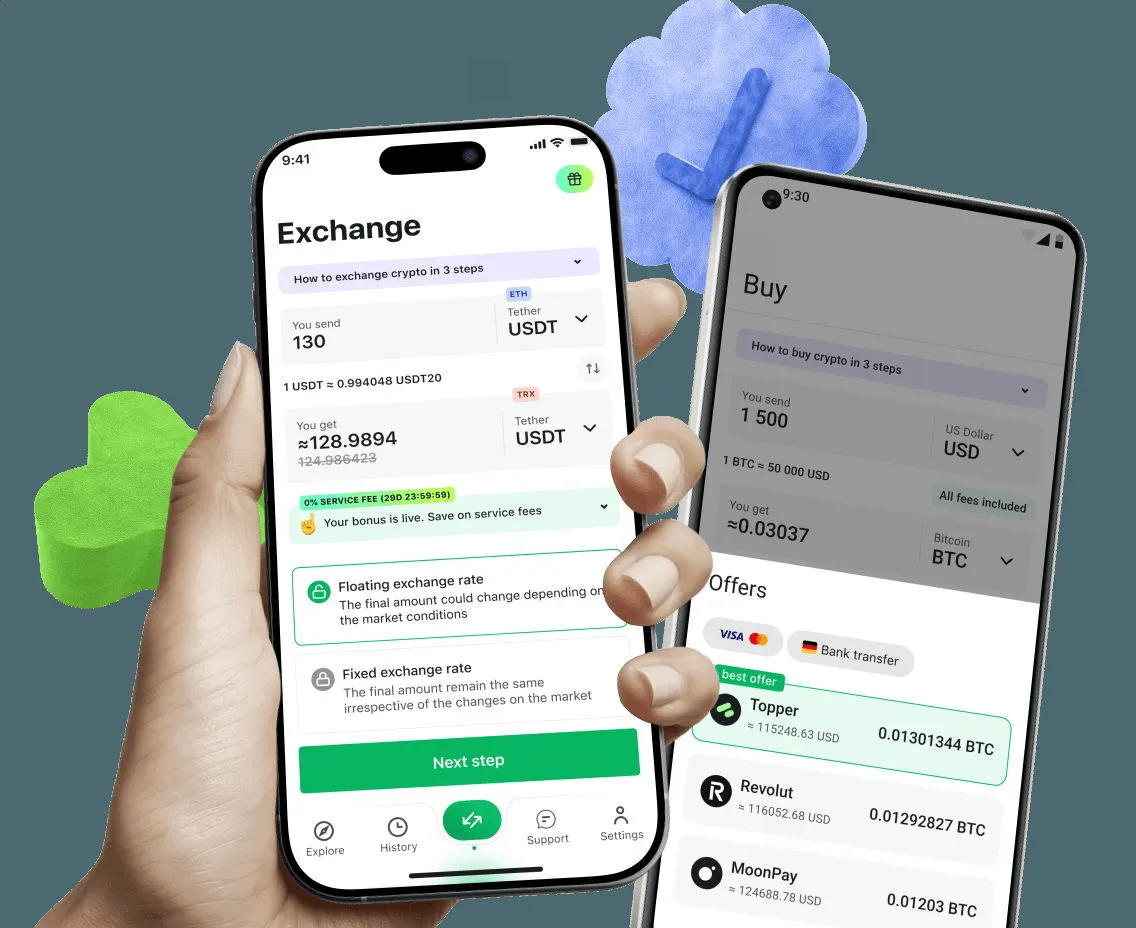
From pay-in transfer to destination settlement
User-visible cross-chain settlement consists of two blockchain transfers with an off-chain conversion between them. The source transfer moves the deposit to the generated pay-in address; after confirmation, a partner venue converts it, and the output transfer reaches the recipient address. These legs are not one atomic transaction. The service temporarily controls the input between receipt and payout even though it does not maintain a persistent customer wallet balance.
The transaction tracker exposes 10 user-facing status labels. Six describe the normal route - Created, Waiting for payment, Confirming, Exchanging, Sending, and Finished - while four describe branches: Hold, Failed, Not paid, and Expired. At 0 source-chain confirmations, the order cannot advance from Confirming. The service frames ordinary processing as 5-40 minutes before blockchain confirmation time is added, so the source network and destination network still set the outer settlement window.
The internal transaction ID is different from either blockchain hash. Keep the order ID, source-chain transaction hash, and payout hash together; those three records identify the off-chain instruction and both on-chain legs. Once the payout transaction is confirmed to the supplied address, the exchange cannot reverse it.
Fixed rates, floating rates, and the full cost boundary
Changelly offers two quote modes with different certainty. A fixed quote commits to the displayed output only when the exact input reaches the assigned address within its payment window. A floating quote executes at the market rate available during conversion, so its final output moves with the venue price while the transaction is underway.
At the API layer, a fixed-rate ID remains valid for 1 minute to create an order. Once created, consumer instructions display a 15-20-minute pay-in window, with the input currency determining the deadline. A floating-rate address remains available for 3 hours. Late funds leave the automated path and are handled under the service's refund or manual-processing rules.
The published cost model has two layers: an exchange fee and a network fee. The floating-rate exchange fee is 0.25% of the output amount for direct transactions; API-partner pricing follows separate terms. Fixed-rate pricing embeds a dynamic protection charge in the quoted rate. The network fee is shown in the payout currency and deducted from the expected output; its amount reflects the destination asset's withdrawal route and network conditions.
Pair limits belong to the quote as well. The minimum must cover the network fee and the market's minimum exchangeable lot, while fixed-rate maximums are constrained because the displayed output must be honored through the selected route. Floating quotes accept amount changes above the minimum, but the received quantity still changes with execution.
Where wallet-to-wallet conversion is genuinely useful
Wallet-to-wallet conversion is useful when the source and desired assets live on different chains and the user does not need an order book. A Bitcoin holder moving into Ether, or an LTC holder moving into USDC, receives a single payout rather than managing a venue deposit, trade, and withdrawal. The live quote screens whether the selected pair and networks are available.
Exact quantity matters across chains because units use different precision. Bitcoin supports 8 decimal places, so 1 BTC equals 100,000,000 satoshis; Ether uses 18 decimal places; and 1 XRP equals 1,000,000 drops. Copying the quoted input avoids rounding a fixed order below its expected amount. It also makes the source-chain hash easier to reconcile with the order record.
This route favors a direct conversion back to self-custody, especially for someone already using a hardware wallet. Its convenience comes with a narrower control set: there are no limit orders, execution venue details remain behind the quote, and compliance review can pause settlement. Repeated trading, precise entry prices, or a need to retain cash balances points toward an order-book venue instead.
Uniswap, THORChain, Kraken, or Coinbase Advanced?
Cross-chain swap alternatives divide into same-chain automated market makers, native cross-chain liquidity networks, and centralized order books. Uniswap executes token swaps through smart contracts on one selected chain. THORChain coordinates supported native Layer 1 assets through inbound vaults and node-signed outbounds. Kraken and Coinbase Advanced accept deposits into custodial balances before an order-book trade and later withdrawal.
THORChain treats a swap quote as valid for 10 minutes, and its EVM router instructions set transaction expiry at least 60 minutes ahead. Those parameters expose more protocol detail than a brokered quote, including the inbound address and memo. Uniswap exposes pool liquidity, approval, gas, and minimum-output settings instead. The extra control also places more transaction construction in the wallet.
| Route | Settlement design | Main failure mode |
|---|---|---|
| Changelly fixed or floating | Temporary pay-in custody, venue conversion, wallet payout | Wrong network, missed deadline, or compliance hold |
| Uniswap | Smart-contract swap against same-chain liquidity | Insufficient gas, missing allowance, or minimum-output reversion |
| THORChain | Native Layer 1 inbound and vault-signed outbound | Expired quote, invalid memo, or paused chain |
| Kraken or Coinbase Advanced | Custodial deposit, order-book trade, withdrawal | Unfilled limit order or unsupported deposit network |
The brokered route fits a one-off cross-chain conversion when the displayed payout, payment window, and intermediary model are acceptable. Uniswap is the more transparent choice for same-chain liquidity; THORChain addresses supported native cross-chain assets without a centralized exchange account. Kraken or Coinbase Advanced provides limit orders and account-based trading, subject to regional eligibility and their supported deposit networks.
Worth knowing
Is an account required to exchange crypto?
An account is not required in the documented crypto-exchange flow. Continuing without sign-in leaves transaction history on the device in the mobile app, while an email or Google login stores history under an account and simplifies support. A KYC request remains possible for a transaction regardless of whether the user created a persistent account.
May the output go directly to a hardware wallet?
The output may go directly to a hardware wallet address that supports the selected asset and network. Ledger and Trezor interfaces are among the documented integrations, but the receiving address still needs the correct chain, token standard, and memo or tag when displayed. The hardware device signs the outgoing transfer; it does not control the intermediary conversion.
What happens if the deposit is below the quoted minimum?
A deposit below the pair minimum does not enter normal automatic conversion. Support may be able to push or refund the transaction, but a refund requires enough value to cover the source asset's return network fee. The missing amount cannot be added later to repair a fixed order, so the original quote and transaction ID remain central to resolution.
How long does a fixed-rate refund take?
A failed fixed-rate order with a supplied refund address is documented as taking up to 1 hour for the simplest refund path. Other recovery categories take longer: deposit timeouts and reused addresses are listed at 1-2 business days, missing memo cases at up to 7 business days, and complex manual cases at up to 20 business days.
Does Changelly provide a wallet for received assets?
Changelly does not provide a persistent wallet for holding the received asset. The user supplies a destination address, and the service sends the exchanged output there after processing. Its generated pay-in address belongs only to the specific exchange order and must not be treated as a reusable deposit account or a place to store funds.
What records should I save after an exchange?
Save the internal transaction ID, the source-chain transaction hash, the payout hash, the quoted pair, and the destination address. The internal ID identifies the service order, while the two hashes identify the blockchain legs. Keeping the displayed rate mode and payment deadline also shows whether the order was fixed or floating and whether the deposit reached the assigned address on time.
First published